Ode to a 113-year-old swimming pool
Todd Barnett writes about caretaking a historic treasure.
I rented a room in a house on Holkham Drive in Ivy when I first moved to Charlottesville in the 1990s and on my first walk around the neighborhood I stumbled on an old rectangular, creek-fed swimming pool in the middle of the woods that was as long as a football field. At the time, I learned, the extraordinary pool had been there for nearly 80 years and was home to the member-owned Blue Ridge Swim Club. In 2011, Todd Barnett bought the historic property, where he hosts his Blue Ridge Field Camp, and continues to offer pool memberships to the public. Here’s something Barnett recently wrote about his experience caretaking the pool. Enjoy! — David McNair
For sixteen springs now I have undertaken a peculiar labor which I suspect has few parallels in modern America….
Each May, in a wooded hollow west of Charlottesville, I set about cleaning and filling a 113-year-old swimming pool with water drawn from the creek below it. To call it a swimming pool is accurate, though incomplete. It is less a modern recreational convenience than a kind of accommodation between man and landscape: a vast concrete vessel laid improbably into the Virginia woods in another age.
It was built by R. Warner Wood, a recent University of Virginia graduate whose family owned the land here in Ivy—or Owensville, if one wishes to be geographically more precise. Wood had founded a boys’ camp here in 1909, drawing campers from across the South, who arrived by train at nearby Ivy Depot, where camp staff would meet them.
Most of what survives of that early world comes through the remarkable photographs of Rufus Holsinger, whose glass negatives remain preserved at the University. In them, boys sit in cabin formations, paddle canoes, and leap into the water. One image has long fascinated me above the others: a broad view from the shallow end, boys lined along the pool’s long edges, the water still. Yet around them, if one looks closely, the earth remains unsettled. Fresh dirt lies heaped along the margins, not yet claimed by grass but instead by pokeweed and other opportunistic colonists that arrive where men have lately disturbed the ground. It is easy to imagine Holsinger being summoned almost immediately after the thing was completed, while the wounds of construction still showed. A note on the photograph indicates it was taken in August, 1913.
The pool has endured, though not unchanged. It was never, I suspect, maintained in the manner of a suburban neighborhood pool—chemically immaculate, scrubbed into sterility, isolated from the world around it. But earlier generations did at least hold the forest at bay. Mid-century photographs suggest a far more open landscape, with lawns and minimal trees, the pool presented plainly to the sun.
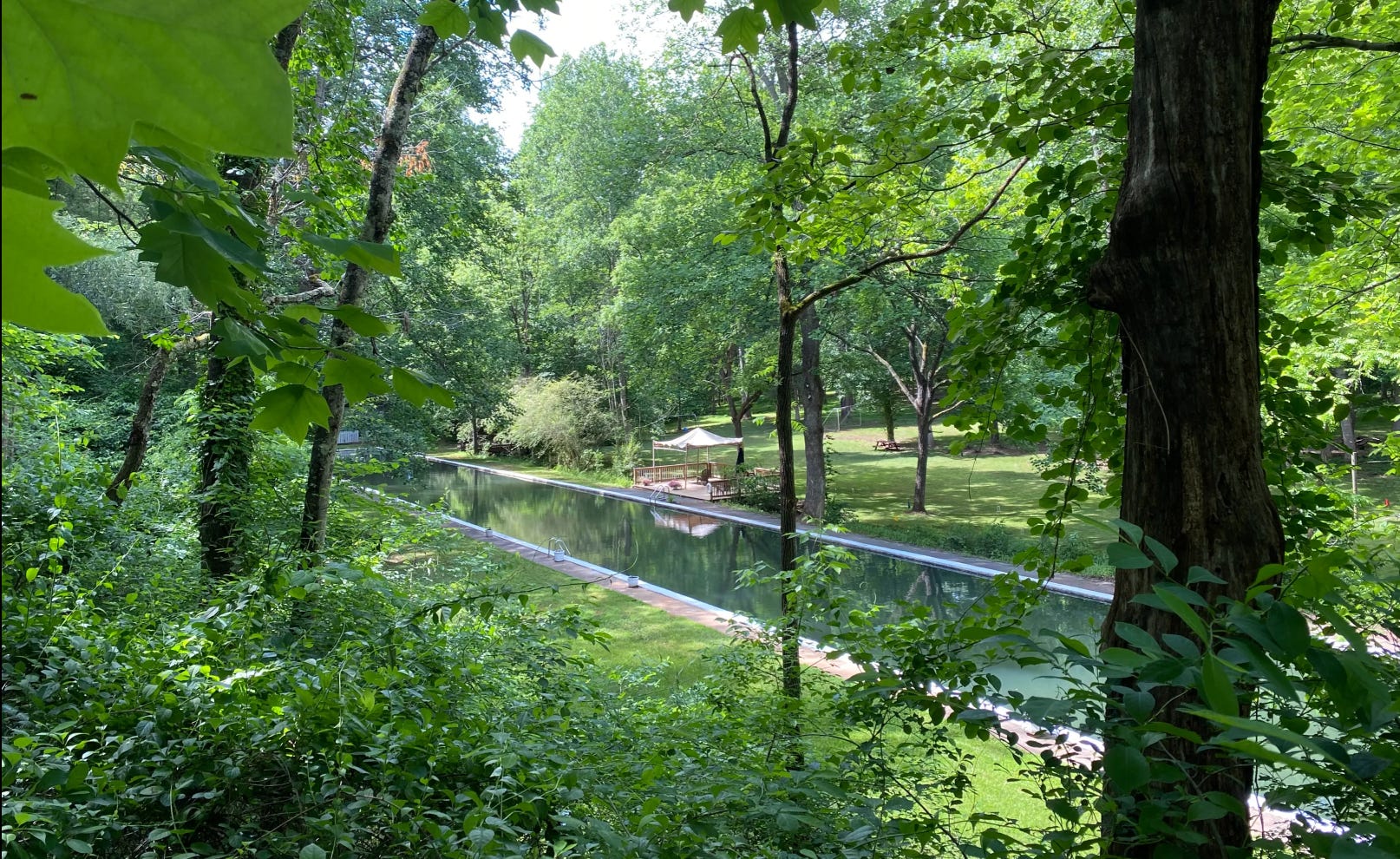
That arrangement has long since reversed itself. Now the woods have reclaimed the perimeter. Tulip poplars tower above the basin in dignified ranks, pale-trunked and astonishingly tall, casting welcome shade and constant debris. In May, their flower buds descend in abundance. Aphids conduct their invisible industry overhead, leaving dark residue that blackens the old mortar beneath them. Leaves, seed husks, twigs, and the innumerable castoffs of woodland life make their annual contributions.
When I bought the place in 2011, I had only the dimmest notion of what ownership would entail. That first spring, club members came to show me the ritual. The pool had been drained and lay exposed in a condition that would have given pause to any sensible buyer. Mud coated the floor. Wet leaves had settled into thick black drifts. Organic muck filled the deep end. We climbed down into it and began. Wheelbarrow by wheelbarrow, we shoveled the accumulated remains toward the shallow end, pushing the loads up a ramp and emptying them into the woods. It was wet, unpleasant, honest labor. One year I attacked the whole structure with a power washer, working my way back and forth down the incline. In some early seasons we cleaned nearly every inch of it, all the way to the deepest drain.
But age, as it does, altered my routine. The pool sits in the water table, which means it is never entirely obedient. Water seeps in when it is empty and seeps out when it is full. Some leaks are plain to see, while others are always slow and seeping. I eventually learned, through practical experience and conversations with owners of similar old pools, that perfect watertightness in such structures is often a fantasy best abandoned. So I learned accommodation. I discovered that much of the muck could be tossed onto a tarp from the deep end with a snow shovel, saving endless wheelbarrow journeys. I ceased worrying about removing every final trace of sediment. Indeed, some modest residue may fill the leaks and slow the leakage. A certain degree of imperfection seems entirely appropriate for a century-old pool in the woods.
This year the spring season has been unusually dry. The creek below, ordinarily energetic, has been subdued, reflecting the lack of rainfall this spring. Seventeen days before opening, I started the fill. On the first day, we gained some 45,000 gallons of water—a seemingly heroic amount until one remembers the appetite of a vessel this size, along with the steady arithmetic of seepage and evaporation. In theory, perhaps ten days might suffice. But we will see. Surely, seventeen days will be enough. Or at least it always has been.
What strikes me now, after all these years, is how few people ever see the pool in its empty state. For most members, Blue Ridge exists as a body of water: long, level, inviting, entirely itself. But for much of the year it is something else altogether. It is a chasm. A hundred-yard trench of old concrete sunk into the earth, improbably deep and wholly dry. We work around it, and walk around it. I have become accustomed to moving along its edge without much thought, though now and then I remember that a misstep would mean a very long fall indeed.
Then, slowly, the transformation occurs. The water rises. Day by day, inch by inch, the void disappears. And then in May, the entire thing has become impossibly flat. Not merely calm, but mathematically level. A hundred yards of stillness stretched through the trees. In off hours, when no swimmers disturb it, the surface becomes a perfect mirror. The towering tulip poplars, the pale sky, the whole extravagant architecture of the woods are reflected with such precision that the pool seems less a body of water than an opening into another world.
The old empty chasm vanishes so completely that one almost forgets it was ever there. But I never do. For I have just stood in its depths (a few days ago, it seems) with shovel in hand, ankle-deep in black spring muck, listening to birds overhead where, weeks later, children will dive. And perhaps that is the peculiar privilege of this labor: to witness not merely the finished beauty, but the annual resurrection itself.
— Todd Barnett


