A Tale of Two Affordable Housing Projects
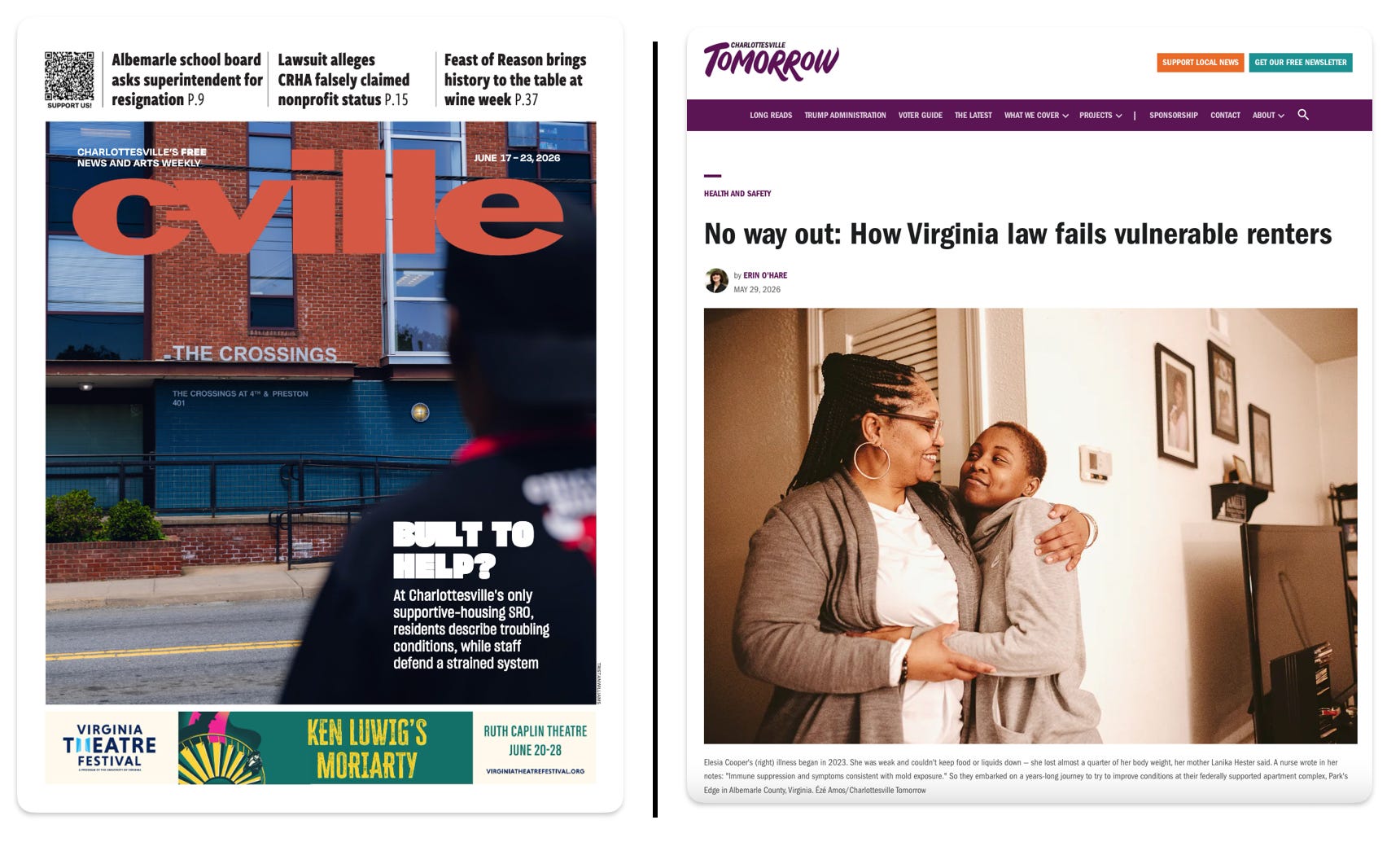
Two recent investigative stories give voice to low-income tenants living in terrible conditions in two very different affordable housing complexes.

As two great local investigative stories have now shown, there’s a dirty little secret about building affordable housing — building them is one thing, and should be celebrated, but caring for and maintaining those properties is another thing.
“I think it (C-Ville’s article) points to one of the shortcomings in our affordable housing finance system, in that there’s relatively little money provided for long-term maintenance and upkeep of properties,” says former Charlottesville Mayor Dave Norris, who spearheaded the effort to create the Crossings, our area’s first supportive housing project at Fourth Street and Preston Avenue. “Unlike Charlottesville Tomorrow’s excellent recent reporting on Park’s Edge, here’s a case where the landlord is responsive and trying to do right by their tenants despite a shortage of resources.”
Indeed, both pieces in C-Ville and CT give voice to low-income tenants living in housing facilities with mold, bugs, and chronic maintenance issues. Often, tenants in this situation don’t saying anything, happy to have housing at all, so the problem goes unreported. But even the best-intentioned affordable housing organizations are dealing with this problem, never mind the private real estate developers trying to turn a profit.
Of course, the Crossings and Park’s Edge are two completely different affordable housing facilities, and while those living at Park’s Edge might be struggling financially, many of those living at the Crossings are or were struggling simply to stay alive. The C-Ville article focuses on recent deaths at the Crossings, hinting at something scandalous, but as I’ve reported here, that’s not uncommon — it’s the result of the damage people who are chronically homeless have endured by the time they arrive at the Crossings.
“The mortality rate among people who’ve been chronically homeless or living on the margins of society is shockingly high,” says Norris. “ I’ve never been to more funerals than when I was Executive Director at PACEM. Living on the streets takes its toll.”
Indeed, back in 2023, I learned that of the 144 people served at the Crossings since it opened (103 homeless and 41 low-income), 19 people returned to homelessness and 30 people died.
“By the time a chronically homeless person moves into the Crossings, so much damage has already been done,” said Norris back then, unsurprised by those numbers. “I personally knew several Crossings residents who died within two or three years of moving in.”
Liz Yohn-Nyberg, then operations manager at PACEM, also knew a man who moved into the Crossings and died several years later.
“It was a perfect situation for him, a great location, exactly what he needed,” she said, “ but there’s a physical cost to being homeless, to being in a shock state all the time, with no access to basic needs. As they say, the body keeps the score.”
As I mentioned, CT did some important work on the situation at Park’s Edge in their recent investigative series, but I was surprised there was no information about the ownership history of the property, which actually is pretty scandalous. Unlike the situation at the Crossings, while tenants suffer at Park’s Edge, a lot of money has changed hands buying and selling the property. Here’s a brief rundown:
The Albemarle Housing Improvement Program (AHIP) bought Park’s Edge in 2002 for $4.2 million.
In the late 1990’s, Albemarle County encouraged the local non-profit organization to take on the property, as the federally subsidized housing credits were set to expire.
“At that time, a lot of apartments were converting to condos in that area or into student housing,” Jennifer Jacobs, AHIP’s executive director, told CT in 2020. “The county didn’t want that to happen. At the time, the property was troubled. It was distressed and had an absentee landlord. It was affordable, but not a nice place for the residents who lived there. [Albemarle County] wanted not only to preserve it but get it in the hands of an organization that would handle it and keep it local.”
In 2018, the Piedmont Housing Alliance (which managed the property for AHIP) approached AHIP and the County with a proposal to buy the property, in hopes of maintaining its affordability and keeping control of the property local, but in 2020 AHIP decided to offer the property for sale for all interested parties.
At the time, CEO Sunshine Mathon worried that some of the potential buyers wouldn’t have the best interests of the tenants in mind.
“We are highly cognizant of how the sale can impact the residents in the long term,” he told CT. “The more we put in a sale price, the less there is for the ability to maintain the property over the long term. If you have more debt on the property, the rent is going towards that and less towards maintenance.”
AHIP ended up selling the property to a mysterious LLC based in Draper, Utah for $7.4 million. TRC Parks Edge LLC then turned around and sold the property to a Maryland-based investment and asset management firm named Railfeild for $11.7 million just two years later. Today, the property is managed by Gates Hudson, a privately-owned real estate management company based in Fairfax.
As for the Crossings, while C-Ville said the return on that supportive housing investment “looks uncertain,” Norris disagrees.
“Despite this one family’s hardships, permanent supportive housing is a remarkably successful model and SupportWorks Housing has a long and commendable track record of managing these kinds of properties - including a number of properties in Richmond and Hampton Roads that have been around much longer than the Crossings,” he says. “If anything, I think this is a call to action that funders need to make sure that dollars are in place to maintain low-income housing and not just build low-income housing.”

